Sequent Real Estate + Wealth Management Call us: 415-918-2243
Strategic Roth IRA Conversions

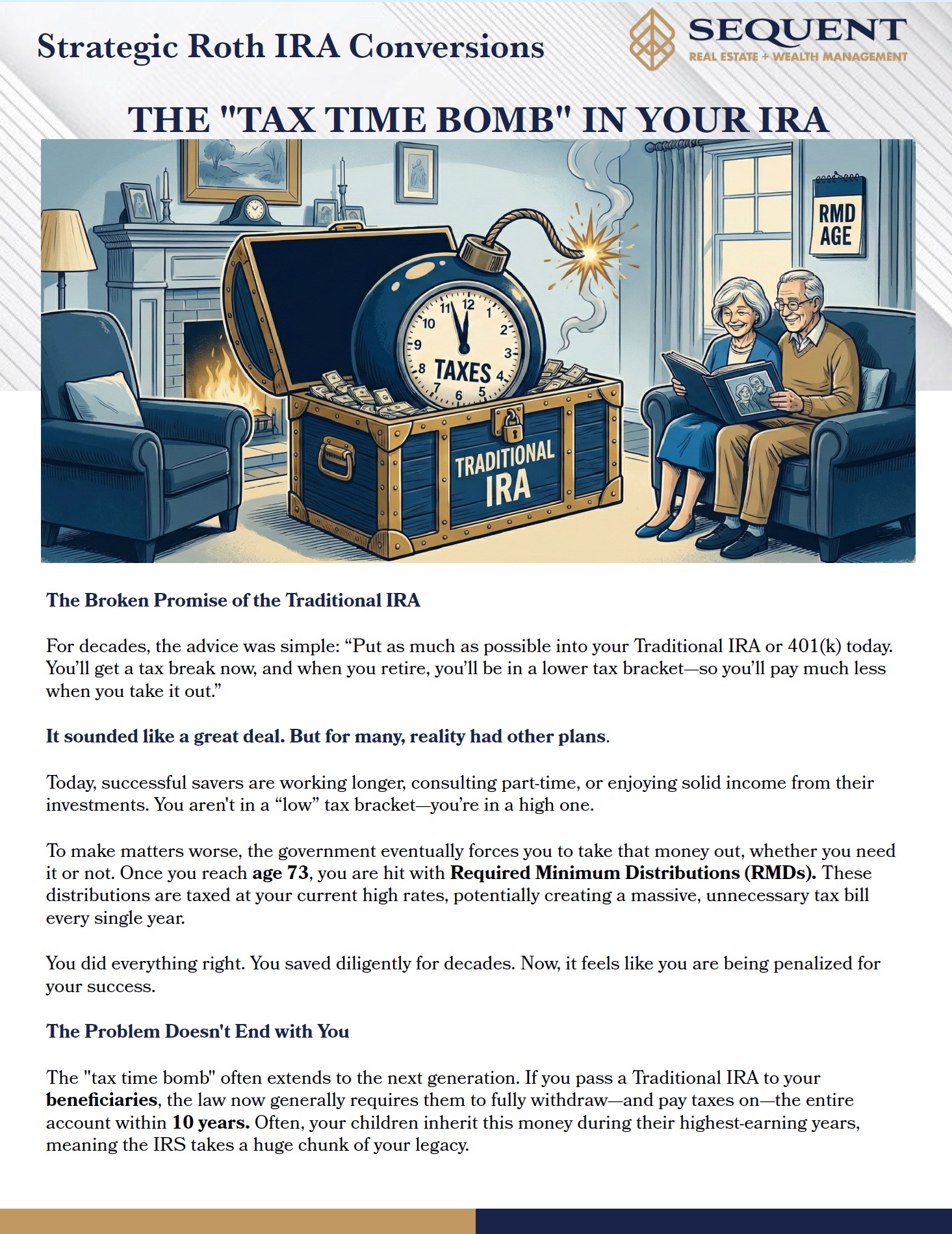
The "tax time bomb"
in your IRA — and how to defuse it

If you have a Traditional retirement account, the IRS owns a piece of every dollar inside it — and that share grows every year. A strategic Roth conversion gives you control over that tax bill and could save your family hundreds of thousands.

Get My Personalized Projection
Eligible accounts
Traditional IRA
SEP IRA
Rollover 401(k)

The promise that didn't pan out

For decades, the advice was to defer taxes until retirement. But for successful savers, retirement turned out to look very different than expected.

You're not in a low bracket

Successful savers often retire into the same — or higher — tax brackets they had during their working years, thanks to investment income, consulting, and continued earnings.

The IRS forces withdrawals

At age 73, Required Minimum Distributions kick in whether you need the money or not. These mandatory withdrawals are taxed at your full marginal rate — every single year.

Your heirs inherit the bill

When you pass a Traditional IRA to your children, the law now requires the entire account to be withdrawn and taxed within 10 years — often during their highest-earning years.

Why a strategic Roth conversion

A Roth conversion isn't just moving money from one account to another. Done strategically — over multiple years, filling tax brackets, managing timing — it's one of the most powerful tools available to high-net-worth retirees.

01

You control the tax rate

Convert during your lowest-income years to lock in today's known rate, instead of letting RMDs force you into unpredictable brackets later.

02

You eliminate the RMD trap

Roth IRAs have no Required Minimum Distributions. Your money can stay invested and growing — on your terms, not the IRS's schedule.

03

Your heirs receive a tax-free legacy

Inherited Roth IRAs pass income-tax-free. With a Traditional IRA, your children pay tax on every dollar — often during their highest-earning years.

The right conversion amount depends on your bracket, your state tax rate, and where you'll source the tax payment. The personalized analysis below models all of it.

Get your personalized analysis

Answer 7 quick questions and we'll model your optimal conversion strategy — bracket-by-bracket math, RMD elimination, and projected legacy impact.

For serious investors only

Before we begin

This strategy is designed for accredited investors with substantial retirement assets. Not everyone qualifies.

I am an accredited investor (Net worth over $1M excluding primary residence, OR income over $200K individual / $300K joint for the past 2 years)
I have $500,000 or more in an eligible retirement account Traditional IRA, SEP IRA, or rollover 401(k). The strategy is most effective at this level and above.
I'm seriously evaluating my retirement tax strategy This is not informational browsing — we'll connect you with a real advisor.
What you'll receive
Personalized Projection
Your custom tax savings and legacy report
Strategic Roth Conversions Brochure
Complete overview of the strategy and how it works
Ground-Up Strategy White Paper
In-depth technical breakdown for sophisticated investors
Question 1 of 7

Let's start with the basics — your name and age.

We'll personalize the analysis with your name throughout.

Question 2 of 7

What's your tax filing status?

This determines which 2026 bracket structure applies to you.

Question 3 of 7

What was your approximate taxable income last year?

This is your taxable income from your 1040 (line 15) — gross income minus the standard deduction and any 401(k)/IRA contributions, NOT your gross salary. Example: a couple earning $180K gross with the $32,200 standard deduction has taxable income around $148K.

Approximate is fine. We'll calculate your bracket and remaining room from this.
Question 4 of 7

What's your Traditional IRA / SEP IRA / rollover 401(k) balance?

The total you'd consider converting. Approximate is fine.

Question 5 of 7

Do you have funds outside the IRA to pay the conversion tax?

Paying the tax from a savings account or brokerage is significantly more efficient — the full converted amount goes into the Roth to compound tax-free. If IRA funds are used to pay the tax, less ends up inside the Roth.

Question 6 of 7

What state do you live in?

State income tax adds to the conversion cost. Several states have no income tax (TX, FL, NV, WA, WY, SD, AK, TN, NH).

Question 7 of 7

What's your investment risk tolerance?

Helps frame the investment options inside your Roth.

Your analysis is ready

Enter your contact info to unlock your full personalized report.

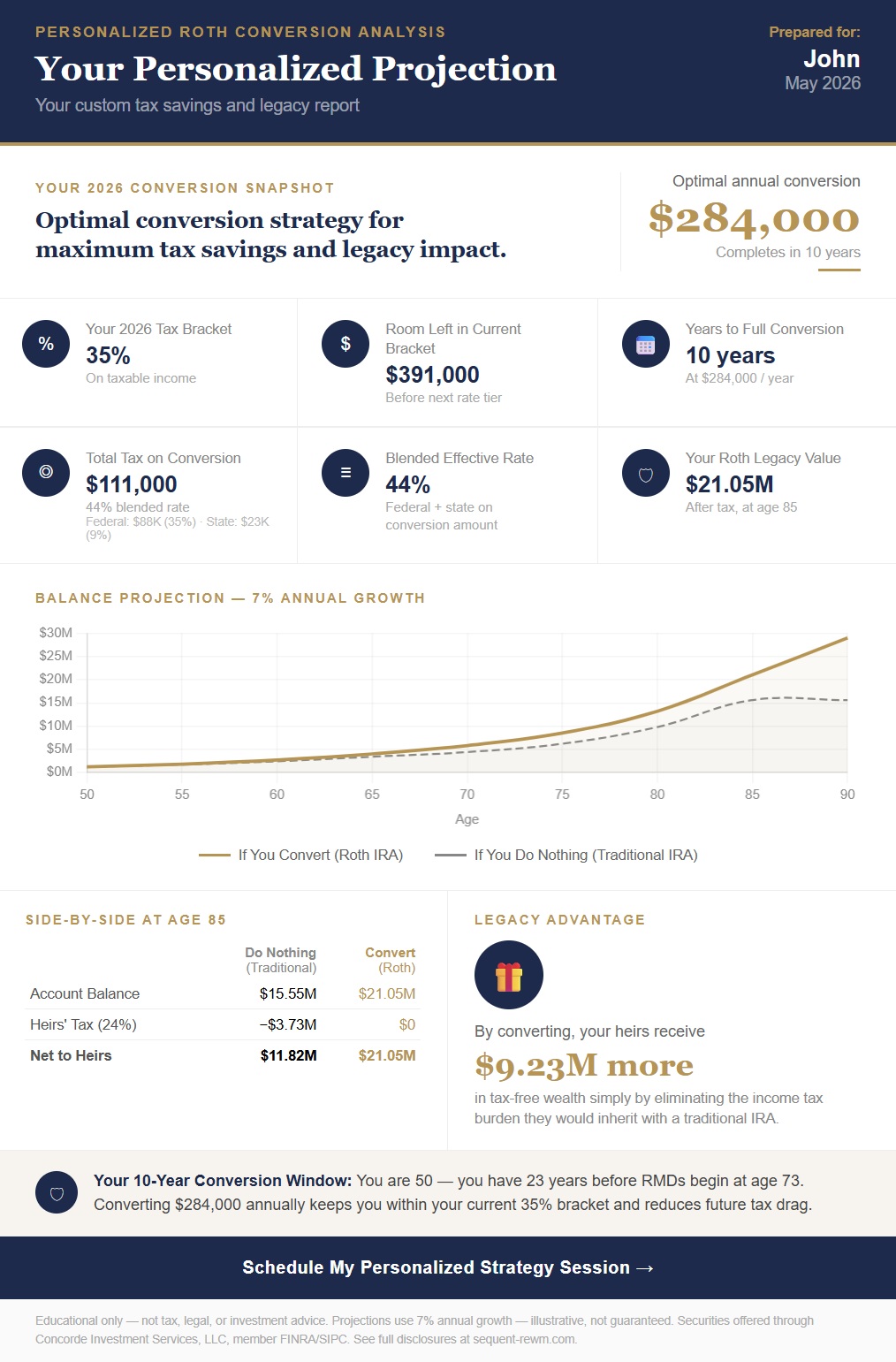
Your Optimal Annual Conversion
$0
Strategically calculated for your age and IRA balance
Unlock your full personalized report: Year-by-year balance projection, RMD trap analysis, estate impact, and 5-step action plan.
We'll send a 6-digit code to verify your number.

Verify your phone

We sent a 6-digit code to

Personalized Roth Conversion Analysis · 2026
's Tax Time Bomb Analysis
2026 permanent tax law (OBBBA) · Prepared
SEQUENT ◆ REWM
⚙ Adjust assumptions
Leave blank to use calculated amount
Your 2026 bracket
On taxable income
Room left in current bracket
Before next rate tier
Optimal annual conversion
Per year
Total tax on conversion
Blended effective rate
On full conversion amount
Years to full conversion

Side-by-side balance comparison
If you do nothing
If you convert
At age 73 (RMDs begin)
At age 85
What heirs receive after tax
Why the gap appears after age 73

Up until age 73, both balances grow at the same rate. The strategies are equivalent in pure growth terms.

Starting at 73, the IRS forces Required Minimum Distributions from a Traditional IRA every year — money pulled out of the account, taxed as ordinary income at your bracket. That's a permanent drag on compounding. Year 1 alone: a withdrawal taxed at .

A Roth IRA has no RMDs. Every dollar keeps compounding tax-free. Over 12+ years, that difference accumulates into the gap you see in the chart below.

Balance projection — 7% annual growth, both scenarios

The estate & legacy cost — most people never see this
What your heirs actually receive after the IRS is done

Under the SECURE Act's 10-year rule, most non-spouse beneficiaries must withdraw an inherited IRA completely within 10 years — and every dollar is taxed as ordinary income at their tax rate. If your children are in their peak earning years (24–32% bracket), your IRA balance is effectively discounted by that percentage before they receive it. An inherited Roth IRA follows the same 10-year rule — but all withdrawals are completely tax-free.

IRA at est. age 85
Heirs' tax (10-yr rule, 24%)
Net heirs receive from IRA
Roth at est. age 85
Heirs' tax on Roth
$0 — tax-free
Net heirs receive from Roth
Legacy advantage: By converting, your heirs receive more in tax-free wealth — simply by eliminating the income tax burden they would inherit alongside a traditional IRA.
What heirs receive after tax — IRA vs. Roth


For qualified investors
There's a way to convert
at a 30–40% discount.
A ground-up real estate development strategy used by sophisticated investors to reduce the taxable basis of a Roth conversion — and capture the upside tax-free.
See how it works →
Schedule My Personalized Strategy Session

Educational only — not tax, legal, or investment advice. Consult a licensed CPA and financial advisor before acting. Projections use simplified assumptions and 7% annual growth — illustrative, not guaranteed. Securities offered through Concorde Investment Services, LLC. See full disclosures at sequent-rewm.com.

Why a Roth IRA

Once converted, the long-term benefits transform your retirement and your legacy.

$

Zero future taxes

All growth and qualified withdrawals are 100% tax-free. The IRS has no further claim on your retirement income.

No required distributions

Roth IRAs have no RMDs during your lifetime. Your capital can stay invested and growing for as long as you choose.

Tax-free legacy

Your heirs inherit the account without facing the 10-year forced withdrawal tax burden of a Traditional IRA.

Common questions

Who is a good candidate for a Roth conversion?
Roth conversions tend to make the most sense for high-net-worth individuals with $500,000 or more in a Traditional IRA or 401(k) who expect to remain in a similar or higher tax bracket in retirement. The strategy is especially compelling for those approaching age 73 — when Required Minimum Distributions kick in — and for anyone with a strong estate planning motive. The sweet spot is often the window between retirement and RMD age, when taxable income temporarily dips.
Why convert over multiple years instead of all at once?
Converting an entire IRA in a single year stacks all of that income on top of your existing earnings, pushing large amounts into the highest marginal brackets. A multi-year approach lets you fill each bracket methodically — converting up to the top of the 22% or 24% bracket each year, for example — and can reduce your lifetime tax cost significantly. The right pace depends on your income, your bracket headroom, your RMD timeline, and your state. That's what this analysis models.
Do I need to pay the conversion tax from outside the IRA?
You don't have to, but it's strongly preferred. When you convert $100,000 and pay the tax from savings, the full $100,000 goes into the Roth to compound tax-free. If you use IRA funds to cover the tax, only $70,000–$80,000 actually enters the Roth — and you've also triggered a taxable distribution on the portion used for taxes. Paying from outside funds is one of the highest-leverage decisions in executing a conversion efficiently.
What happens to my RMDs if I convert?
Roth IRAs are not subject to Required Minimum Distributions during the account owner's lifetime. As you convert your Traditional IRA balance into a Roth, you permanently reduce — and eventually eliminate — the mandatory annual withdrawals the IRS would otherwise force at age 73. This gives you full control over when and how much you take out, and keeps more capital compounding tax-free for longer.
How does this affect what my heirs receive?
Under the SECURE Act's 10-year rule, most non-spouse beneficiaries must fully withdraw an inherited IRA within 10 years — and pay ordinary income tax on every dollar. For children in their peak earning years, that can mean 24–32% or more going to the IRS before they see a cent. An inherited Roth IRA follows the same 10-year rule, but all withdrawals are completely tax-free. For many families, the estate planning benefit alone justifies the strategy.
What happens after I submit my information?
You'll receive your full personalized projection by email immediately. A Sequent advisor will follow up within one business day to answer questions and discuss whether this strategy is a fit for your situation. There is no obligation and no sales pressure — if it's not the right fit, we'll tell you.